
Anyone who has run a data extraction team knows the feeling: the hub is finally done, the deliverable is packaged up, and someone asks the question that has no good answer: “how accurate is it?”
Without checking every single asset in a dataset, it’s difficult to know the accuracy of a dataset. And checking every asset defeats the purpose of efficient extraction in the first place. That loop, extract, hand off, hope, get called back in when a client finds an error, is one of the most expensive and least defensible cycles in the geospatial services business. It burns hours, damages trust, and rarely produces a real answer about dataset quality.
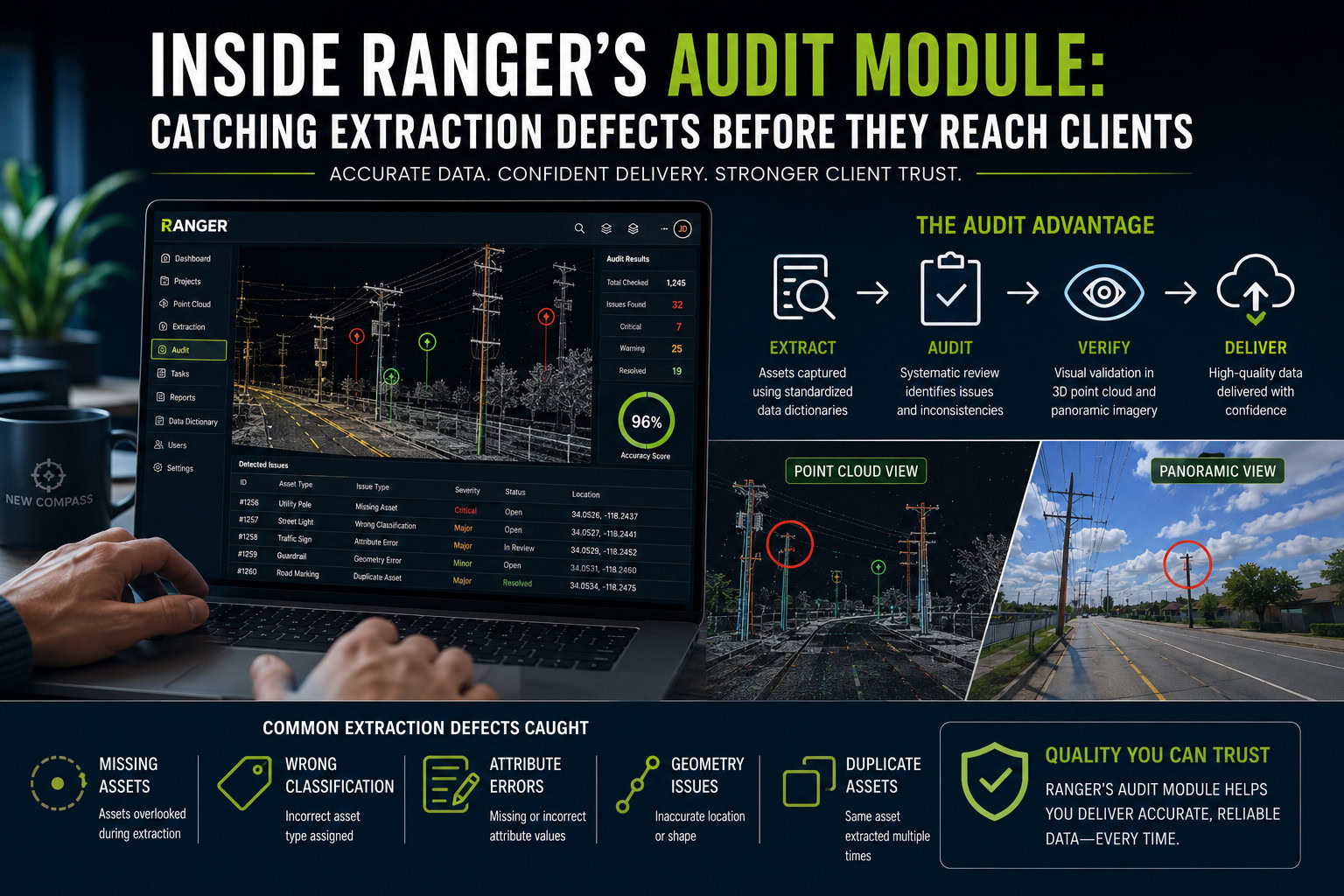
We built Ranger’s Audit module because we want to end the ambiguity. It’s a direct response to a problem we understand from years of experience, and it is a solution we use every day to produce more quality deliverables.
How the Audit module works
Once a hub has been fully extracted, it can be switched into Audit mode. From there, a PM assigns extractors one of two audit task types.
Missing audits guide an extractor through defined areas of the dataset, checking systematically for assets that should have been captured but weren’t. If something is missing, the extractor flags it and moves on, with no time lost re-deriving what “should” be there.
Defects audits guide an extractor through a sample set of already-extracted assets, checking for geometry and placement errors as well as attribute table errors. Rather than re-reviewing an entire dataset, the extractor works through a defined, representative sample.
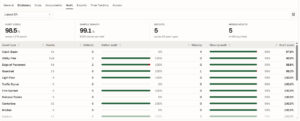
Once all audit assignments are complete, Ranger generates a Quality Score for the dataset based on the number and type of errors identified, broken down by asset type. That breakdown matters: a project can look strong overall while one asset type (signs, poles, striping, whatever it may be) is quietly underperforming. Surfacing that detail is what makes the score useful rather than just reassuring.
Why sampling, not a full re-check
The Quality Score isn’t a gut check. It’s built on statistical sampling, a well-established QC methodology used across manufacturing, engineering, and inspection disciplines. Sampling a representative portion of a dataset produces a defensible, quantifiable accuracy measure without the cost of a full manual re-review. That’s the balance the Audit module is built around: rigor without redundant labor.
For a client, that means a number they can actually stand behind, not “we’re pretty confident” but a documented score, broken down by category, produced through a repeatable process. For a PM, it means knowing exactly where quality is slipping before a client ever has to ask.
Built for how extraction actually happens
One thing we were careful about: the Audit module doesn’t assume a single extraction method. It works the same way whether the underlying assets were extracted manually, pulled from an automated extraction pipeline, or produced by some mix of both, which is how most real projects actually run.
That matters because QC can’t be an afterthought bolted onto only part of a workflow. A tool that only audits manual work, or only audits automated output, isn’t solving the actual problem: it’s solving half of it. Ranger’s Audit module is built to close the loop on the whole dataset, regardless of how each asset got there.
The result
The Audit module turns “how good is this dataset?” from an open question into a documented answer. It gives PMs a structured way to assign QC work, gives extractors a clear task instead of an open-ended re-check, and gives clients a defensible, asset-level quality score they can actually use, not just a sign-off.
That’s the difference between an extraction tool and an extraction tool built for real projects. We didn’t add the Audit module because it sounded good in a feature list. We added it because we believe it is a crucial part of delivering a usable extracted dataset.